Cheese Factory Inventory: From a Single Number to Lots, Expiry and a Full Ledger
Most inventory software gives you one number per material: "rennet: 1800 ml". But a factory owner needs to know which rennet pack went into which cheese batch, when it expires, what it really cost, and how many litres are in each milk tank and at what fat now. Lebnara inventory is built on this: every receipt is a lot with a number and expiry, and every movement is recorded in a ledger from which nothing is deleted.
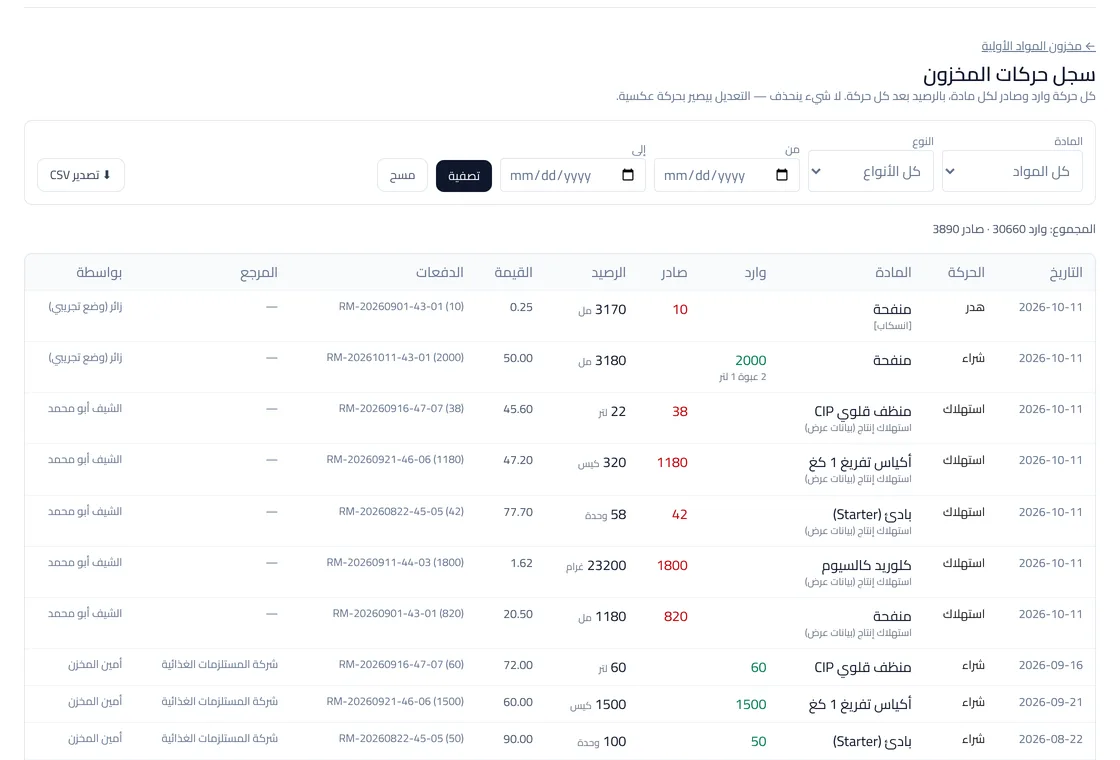
A full movement ledger for every material
Every purchase, consumption in a production batch, waste and stock-count adjustment is recorded as its own movement with the balance after it, who recorded it, and its reference. Editing a production batch does not erase its old consumption; it adds a reverse movement that returns the quantity to the same material lots. The ledger therefore stays true to reality and fit for review and audit.
The balance and weighted average cost are calculated inside the database itself on every movement, so the figure does not differ if two employees record at the same moment. You can filter the ledger by material, type and period, and export it to CSV that opens in Arabic in Excel.
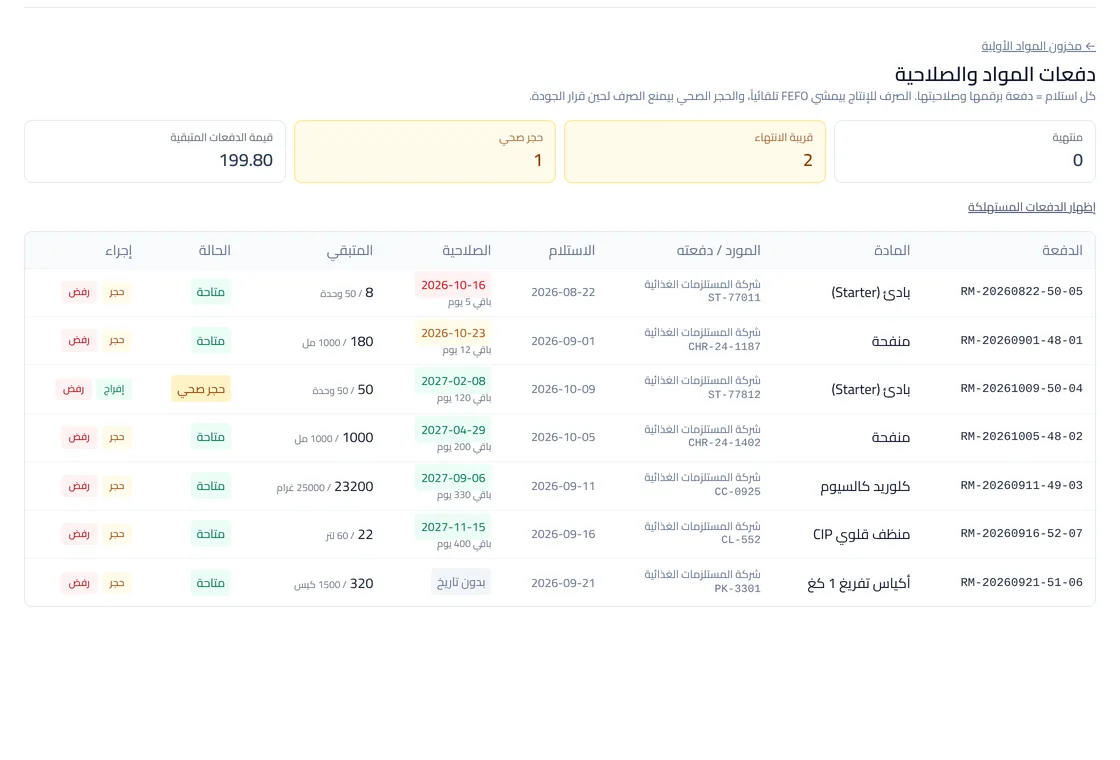
Material lots and their expiry
- Every purchase receipt becomes a lot with an automatic number, the supplier lot number, expiry date and price.
- Issuing to production draws automatically from the lot that expires first (FEFO), and continues from the next if it is not enough.
- An alert before expiry by a number of days you set per material: rennet 45 days and starter 30, for example.
- Quarantine a lot until the quality controller inspects it: it is not issued to production before release.
- Reject a lot or destroy what remains in one click; the destruction is recorded as waste with its reason.
Precise tracing on any complaint
The production batch traceability page now shows the material lots actually drawn: the rennet lot number, its supplier, the supplier lot number, expiry and quantity. If a supplier notifies you of a recall of a specific lot, you immediately know which cheese batches used it and which customers bought them.
Purchase units and real cost
- Buy by the carton, sack or gallon, and issue by ml, gram or piece. The software converts quantity and price automatically.
- A moving weighted average cost updates with every receipt, so the cost per kilo stays correct even if you buy the same material at different prices.
- Material categories: ingredients, packaging, cleaning and sanitising, spare parts, with storage type (chilled, frozen, dry).
A specific dose for each product
Halloumi does not take the same rennet dose as Akkawi. So you can set the dose of each material per product (per 100 kg of milk), and if left empty the material's general dose is used. The specific dose is applied automatically in production batches and in the Chef Board, making each product's cost more accurate.
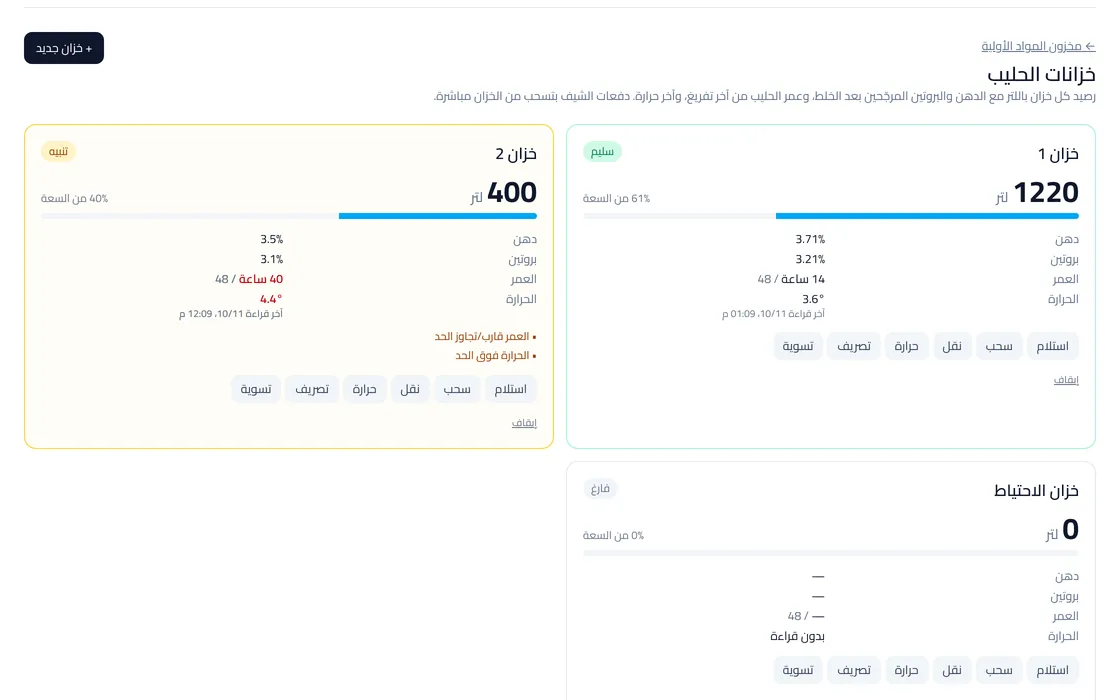
Milk tanks: how many litres, what fat, and since when
Each cooling tank has a balance in litres, fat and protein percentages calculated by weighted average after every mix, the milk's age since the last emptying, and the last temperature reading. The software alerts you if the age nears the limit (48 hours by default) or the temperature exceeds 4°C.
You record receipts from the farm or a supplier, transfers between tanks, and draw-offs. When the chef starts a batch in the Chef Board he chooses the tank, the fat and protein fill in automatically, and the quantity is drawn from the tank when the milk is accepted.
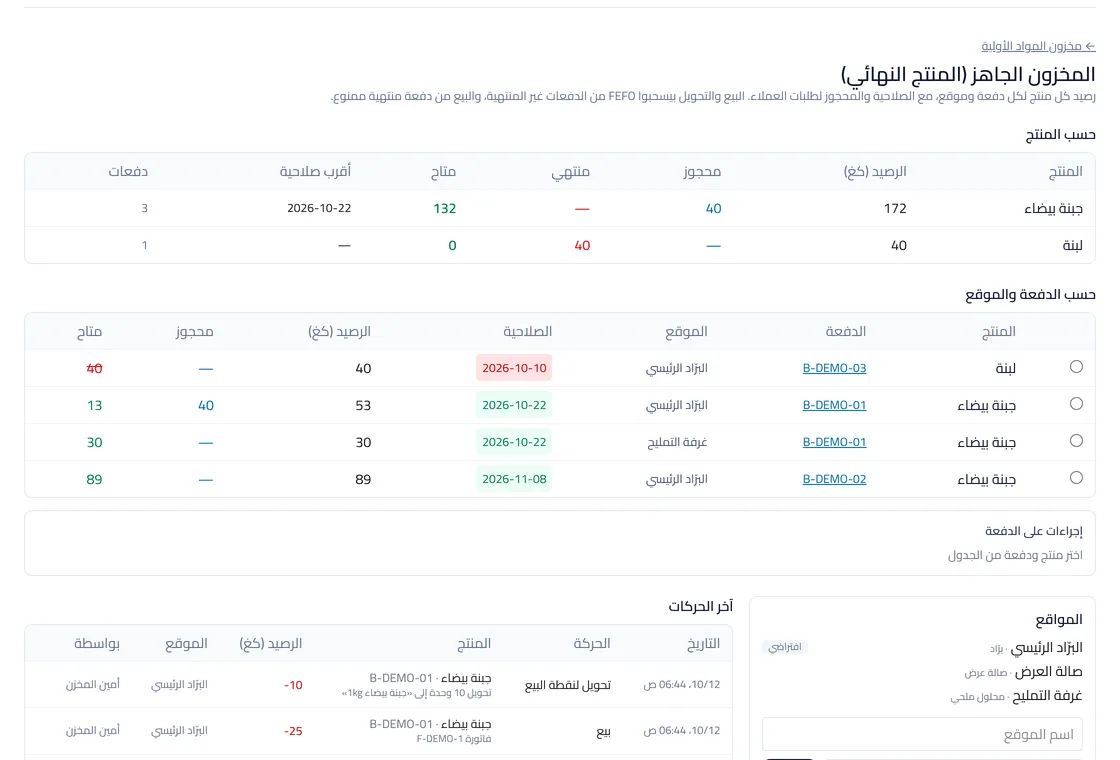
Finished product by batch and location
Every production batch enters finished stock automatically with its expiry: the cold store, the salting room or the showroom. For each product you see the balance, reserved, expired and what is actually available to sell.
Selling draws from the batch that expires first, and the software blocks selling or transferring to the POS from an expired batch. Returns go back to their own batch, saleable or destroyed, with a credit note to the customer.
Customer orders, reservation and price lists
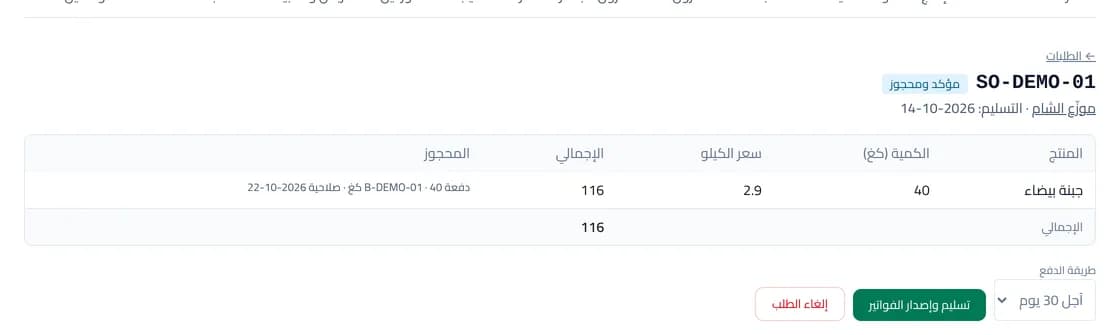
A distributor's order starts as a draft at his price list (wholesale, retail, special customer or seasonal). On confirmation the software reserves the quantity from the batches expiring first, so the same cheese is not sold twice. On delivery each line becomes an invoice from the same reserved batches.
Purchase orders and automatic drafts
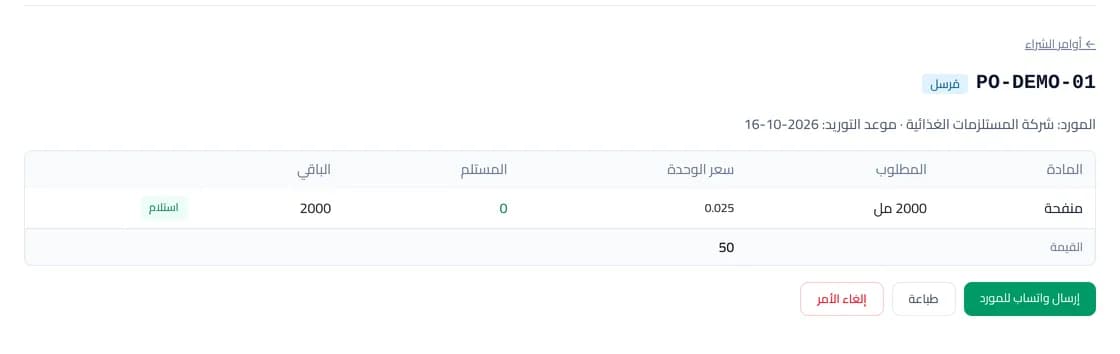
In one press, draft purchase orders are created from each material's reorder point, lead time and minimum order, grouped by supplier and rounded to the purchase unit. You send the order to the supplier on WhatsApp and receive it in part or in full, and every receipt becomes a lot with its number and expiry.
The main inventory screen
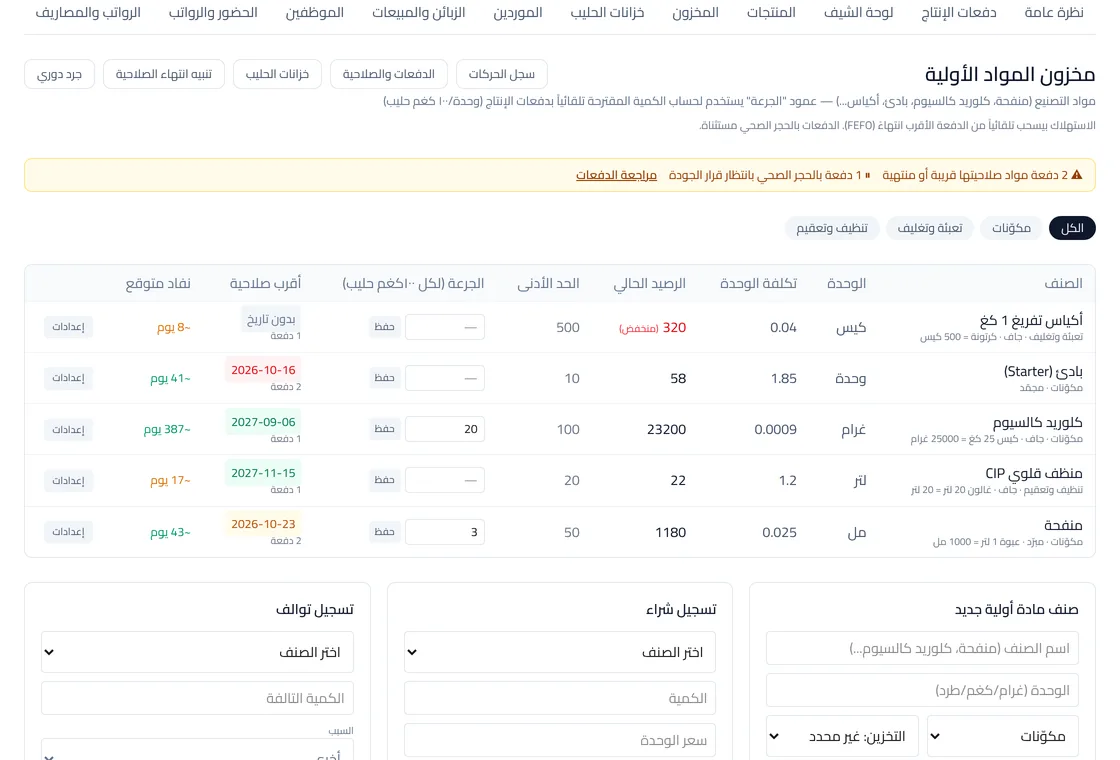
- Balance, minimum level and a forecast of the run-out date from the consumption rate.
- The nearest expiry of each material and its number of lots, and an alert for lots near expiry or in quarantine.
- Periodic stock counts whose differences are applied as adjustment movements in the ledger, not by overwriting the balance.
Frequently asked questions
- Is inventory management included in the factory subscription?
- Yes, it is part of the cheese factory module ($20 per month), together with the Chef Board and milk tanks, at no extra charge.
- What does FEFO mean?
- First Expired, First Out: what expires first is issued first, not what arrived first. It is the accepted rule in the food industry to reduce waste.
- I have old stock without lot numbers. What happens to it?
- It stays as an opening balance without a lot and is issued after the recorded lots are used up. From the first new receipt, lots start with their numbers and expiry.
- Can a wrong movement be deleted?
- Movements are not deleted, to protect the ledger. Correction is by a reverse movement or an adjustment, and both appear in the ledger with who recorded them.
- Do I need a barcode scanner?
- No. Everything can be recorded manually from a phone or tablet, and a barcode can be saved for each material.
- Does it stop me selling expired cheese?
- Yes. Selling from a customer page, delivering an order or transferring to the POS is refused if the batch is expired, and automatic issuing skips expired batches.
- Can I try it before subscribing?
- Yes. The demo has materials with different lots and expiry, a lot in quarantine, milk tanks, finished stock with an expired batch, a reserved customer order and a sent purchase order.
Try Lebnara now, no sign-up
A full demo company with every module, opens instantly.