Chef Board: Step-by-Step Cheese Production Control
Good cheese does not come by luck but from controlled numbers at every stage. The Chef Board in Lebnara is a screen for the factory chef that walks him through the batch step by step: he records the milk analysis, and the software calculates how much milk goes through the separator, the rennet dose and the cutting time, and compares every pH and temperature reading to target instantly. When the batch is closed it is posted automatically to production batches and the cost per kilo.
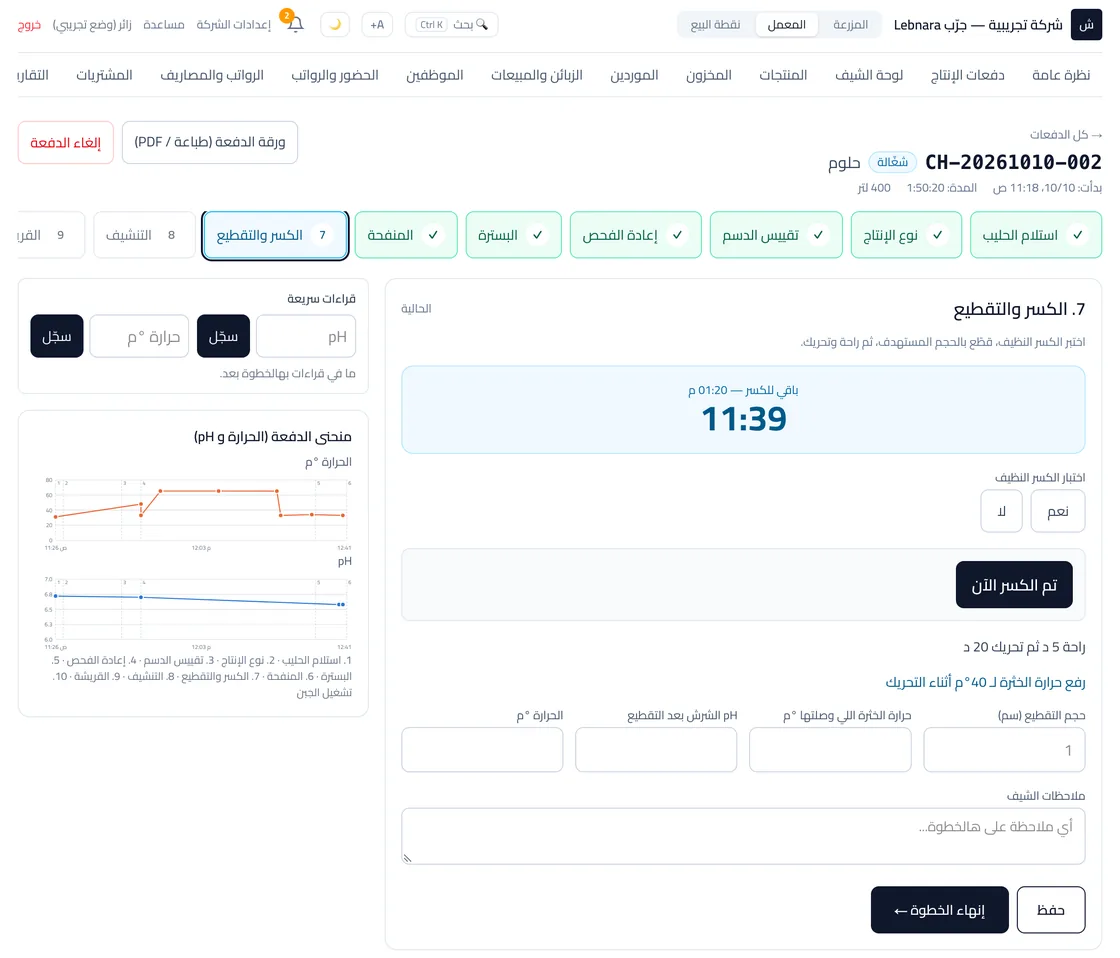
Ten steps in order, so no stage is forgotten
Every batch goes through ten steps locked in order: the next step does not open until the current step's readings are entered. Every shift works the same way, and every batch has a full record to refer to in any complaint or inspection.
| Step | What the chef records | What the software calculates |
|---|---|---|
| 1. Milk receipt | Quantity, fat, protein, SNF, density, pH, acidity, antibiotics | Automatic acceptance check and an alert on any out-of-range value |
| 2. Product type | Choose the product card (Akkawi, halloumi, shanklish, white cheese...) | The batch's technical targets and the theoretical yield for this milk |
| 3. Fat standardisation | Separator cream fat and the action taken | Target fat, separator litres and cream quantity |
| 4. Re-test | Fat, protein and pH after standardising | Comparison to target and tolerance |
| 5. Pasteurisation | Temperature and holding start and end time | Holding timer and temperature and duration check |
| 6. Rennet | Rennet strength and time of addition | Dose in ml or grams, calcium chloride, and cutting time |
| 7. Cutting | Clean-break test and cut size | Countdown to cutting time |
| 8. Draining | Whey quantity, pH and pressing time | Pressing timer, and moving the whey to the ricotta step |
| 9. Ricotta (optional) | Whey used, temperature, acid and weight | Acid dose and ricotta yield |
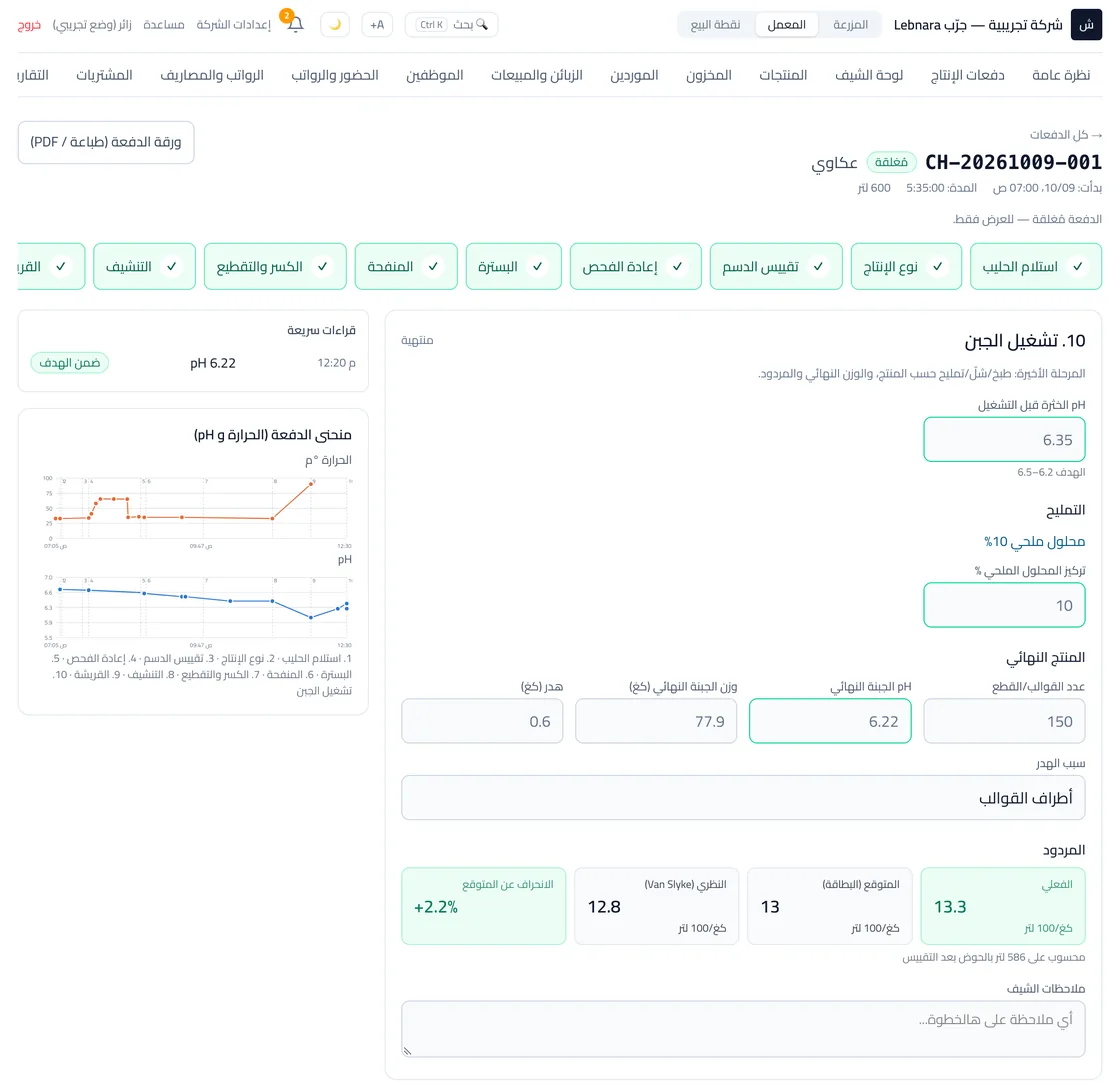
| 10. Cheese finishing | Cooking or stretching, brine, final weight | Actual yield against expected and theoretical |
Fat standardisation by protein-to-fat ratio
Milk fat changes with the season, the feed and the milking time, and with it the softness and yield of the cheese from batch to batch. The accepted fix in cheese factories is standardisation: setting the protein-to-fat (P/F) ratio of the vat milk to a fixed number for each cheese type.
Enter the fat and protein percentages from the analyser, and the software calculates the target fat, how many litres must pass through the separator with the skim returned to the vat, and the cream that will come out for butter or clotted cream. If the milk fat is lower than required, it suggests how much cream to add, or an alternative by drawing off some skim.
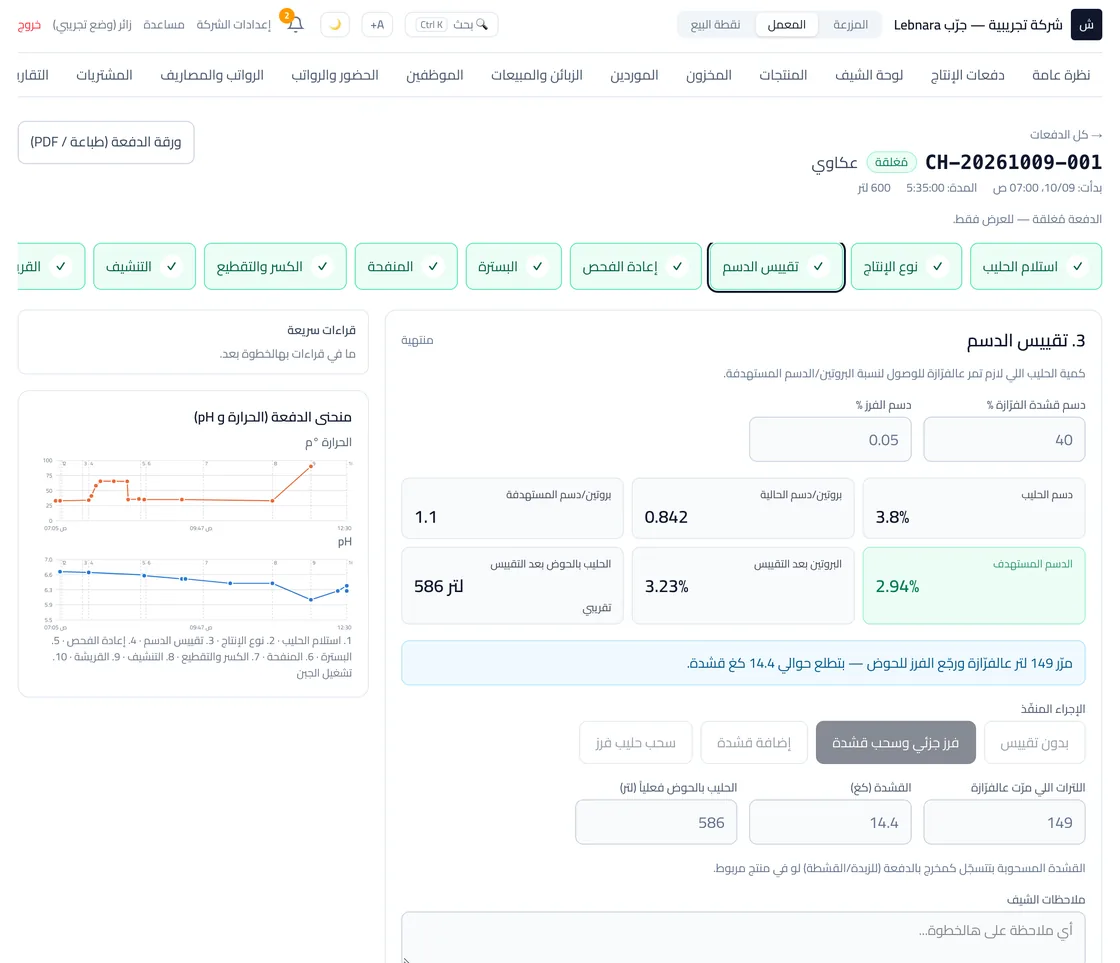
Rennet dose and cutting time, precisely
The rennet dose is calculated from the strength printed on the pack, whether in IMCU units or a 1:N ratio, and from the actual milk in the vat after standardising, for liquid or powder rennet. The software also calculates the calcium chloride and starter culture if used.
When you press "Rennet added", a countdown to the cutting time starts. If the chef records the observed flocculation time, the time is recalculated with the flocculation-factor method, the most accurate way to fix curd firmness.
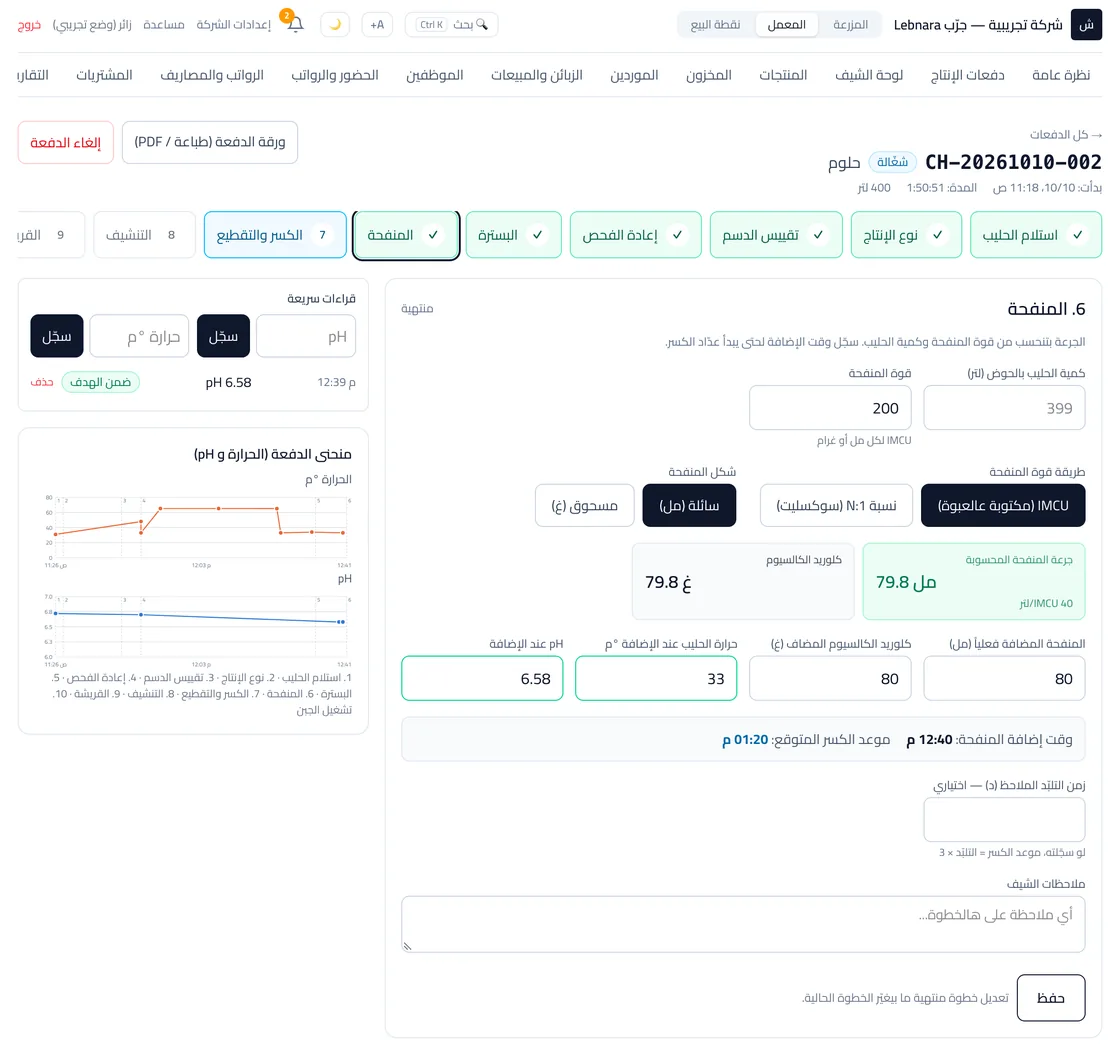
pH and temperature readings against target
- Each step has a target pH range from the product card, and every reading shows instantly in green, yellow or red.
- A timer for the pasteurisation holding time, with an alert if the temperature or duration is below requirement.
- Quick repeated readings for any step, and a temperature curve and a pH curve covering the whole batch.
- For shanklish-type products, for example, the software warns you if the curd has not reached the required stretching pH before stretching.
Actual yield against expected and theoretical
After the final cheese is weighed, the software shows the actual yield in kilograms per 100 litres of milk and compares it to the yield expected in the product card and the theoretical yield calculated with the Van Slyke equation from the milk analysis and cheese moisture. A large deviation means whey loss, unsuitable cutting or weaker milk, so you find the problem on the day.
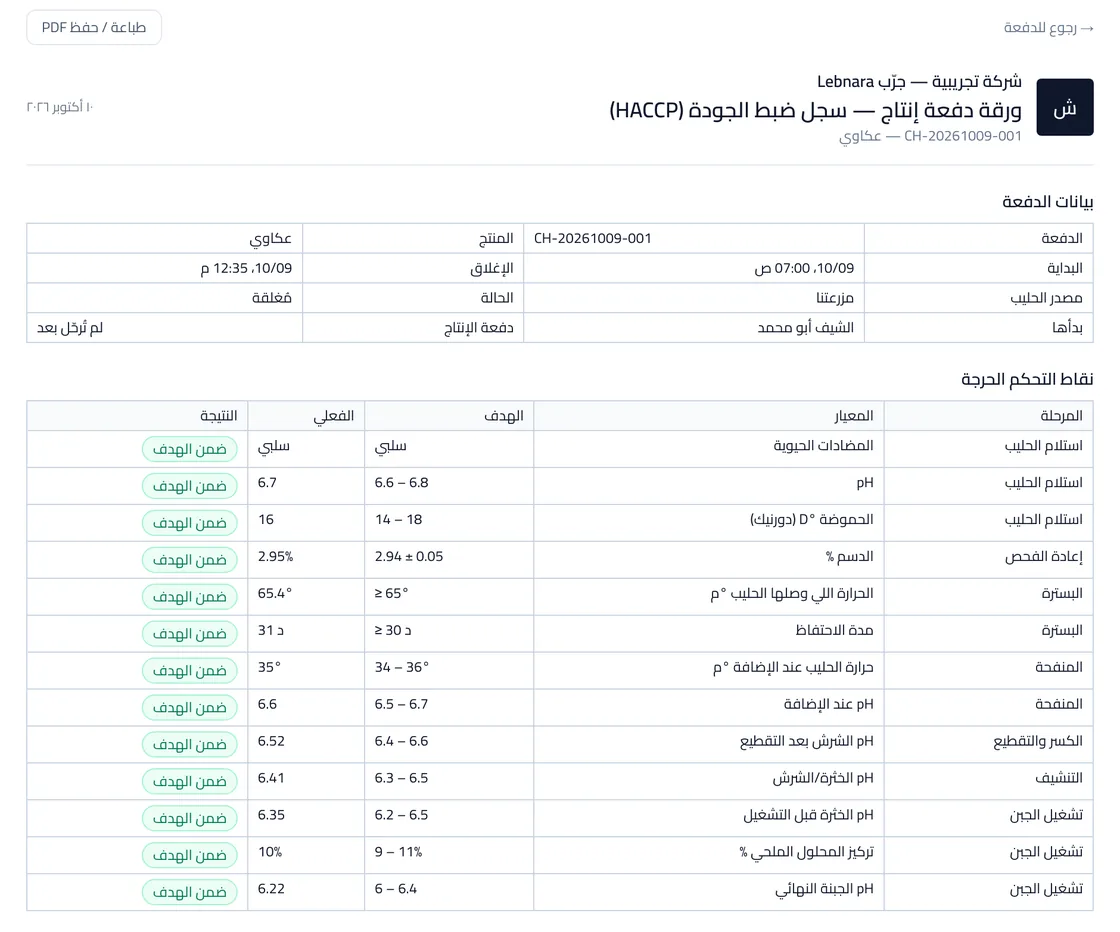
A print-ready HACCP record
Every batch has a sheet ready to print or save as PDF, listing the critical control points against their targets: antibiotics, milk pH and acidity, pasteurisation temperature and holding time, pH of each stage, and brine. With it comes the step log with values and the chef's notes, the readings, the yield, and signature boxes for the chef, quality controller and factory manager.
A product card for each cheese type
The Chef Board comes with ready cards for Akkawi, halloumi, shanklish and local white cheese, and you can add a card for any other product. Each card holds the technical targets: protein-to-fat ratio, pasteurisation temperature and time, coagulation temperature and rennet dose, cut size, cooking or stretching, brine concentration, pH ranges and expected yield.
The defaults are a starting point for cow's milk, and the factory owner calibrates them to his milk and equipment. Each batch keeps a copy of the card as it was when chosen, so editing the card later does not change the record of old batches.
Built for the factory floor
- Large buttons and fields suited to a tablet in the production hall.
- Works even if the internet drops: readings and steps are saved on the device and sync automatically when the connection returns.
- A "Chef Board only" permission: the chef sees the production screen alone, without costs, salaries and customers.
- Fully Arabic right to left, with an English interface when needed.
Linked to the rest of the factory accounts
When the batch is closed, a normal production batch is created with the incoming milk and its supplier, the raw materials according to the product recipe, the resulting cheese and waste, and the cream drawn off if it has a product. Ricotta is recorded as a sub-batch of the whey. The real cost per kilo is then calculated automatically with fixed costs, as for any other batch.
Frequently asked questions
- Is the Chef Board included in the factory subscription?
- Yes, it is part of the cheese factory module ($20 per month) at no extra charge.
- Do I need a milk analyser?
- It is enough to enter the fat and protein percentages from any analyser or lab. Protein is needed to calculate standardisation by protein-to-fat ratio.
- Can the chef see only this page?
- Yes. When adding the employee choose "Chef Board only", and he sees the production control screen without the rest of the factory sections.
- What happens if the internet drops during a batch?
- Work continues. Steps and readings are saved on the device and sent in order automatically when the connection returns.
- Are the default values right for my factory?
- They are a considered starting point for cow's milk. After the first batches, adjust each product card to your milk, equipment and actual results.
- Can I try the Chef Board before subscribing?
- Yes. The demo has ready sample batches: a closed Akkawi, a halloumi running at the cutting step, and a rejected milk batch.
Try Lebnara now, no sign-up
A full demo company with every module, opens instantly.