Cheese and Dairy Factory Management and Costing Software
The hardest question a cheese factory owner faces: what does a kilo of cheese really cost me? Lebnara answers it for every production batch, because it ties incoming milk, raw materials, labour and fixed costs to the kilograms actually produced.
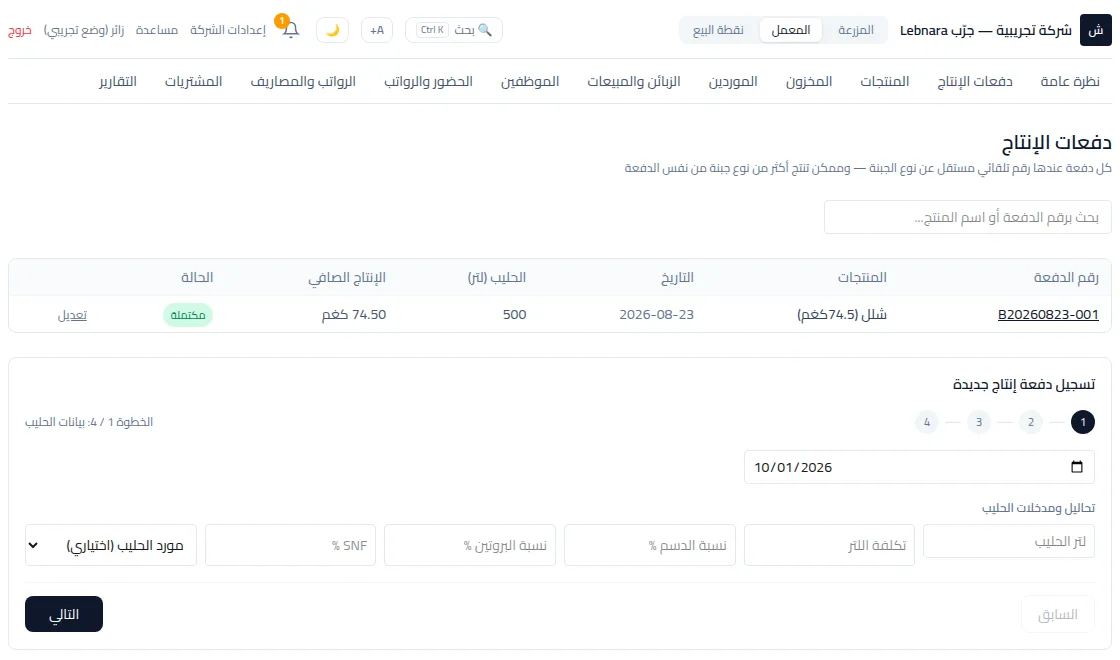
Production batches, step by step
Each batch is recorded in four steps: milk data (quantity, cost per litre, fat, protein and SNF percentages, supplier), then raw materials, then labour, then outputs and waste.
Each batch gets an automatic number, and one batch can yield more than one type of cheese. The software suggests the dose of each raw material per 100 kg of milk according to the product recipe.
The real cost per kilo, not an estimate
Most small factories cost from milk alone, which shows profits that do not exist. Lebnara adds every cost:
- The cost of the raw milk used in the batch.
- Raw materials: rennet, salt, calcium chloride, starter cultures and more.
- Labour on the batch.
- Monthly fixed costs (rent, electricity and water, salaries, maintenance), spread automatically over 26 working days and then over the kilograms actually produced.
- Purchases classified as direct costs on a specific batch, kept separate from general expenses.
Full traceability
Every batch has a traceability page showing the production journey from incoming milk and its supplier to the final product, including the raw-material lots actually drawn, the supplier lot number and expiry. This matters for quality control and for answering any complaint or regulatory review quickly.
Inventory, suppliers and customers
- Raw material stock by lot and expiry with automatic FEFO issuing, a full movement ledger, and milk tanks with fat and protein after blending.
- Raw material stock with a minimum level and a low-stock alert.
- Product definitions (white cheese, Akkawi, halloumi, shanklish, labneh...) with each product's shelf life, and alerts for products close to expiry.
- Supplier and customer balances (shops and distributors), their debts and payments.
- An alert when the yield (kilograms produced per litre) drifts from the normal range.
Brine and ageing for halloumi and Akkawi
- Record for each brine tank: target salinity, temperature and pH limits, and brine change interval.
- Salinity readings as a percentage or in Baumé degrees, with the amount of salt or water needed to return to target.
- An immediate alert when salinity, temperature or pH goes out of range, and when the brine is due for changing.
- Ageing batches linked to the production batch, with a ready date, weight checks and weight-loss percentage.
Energy cost (gas + electricity + diesel) in three ways
- Monthly: you set the energy cost per kilo yourself.
- Learning: the software learns from last month's actual energy expenses and applies them to the new month automatically.
- Calculated: answer a few simple questions (gas cylinders, diesel, electricity bill, weekly output) and it estimates the cost per kilo and per 100 litres of milk.
- No double counting: energy expenses leave the general cost pool when they are charged at their own rate.
Van sales on the distribution route
- Load the van from the cold store with the same lots and expiry dates (FEFO).
- Sell to shops from the van's stock only, at each customer's price list, cash or credit, with a tax invoice.
- Collect customer debts during the round (cash or CliQ).
- End of day: return what is left to the cold store, with a summary of loaded, sold and returned items and the cash to hand in.
Reports
A chart of the cost-per-kilo trend over the months, a best and worst product report, and a unified profitability report combining the factory with the farm and the POS. Every report exports to CSV or PDF carrying your company logo.
New: the Chef Board for production control
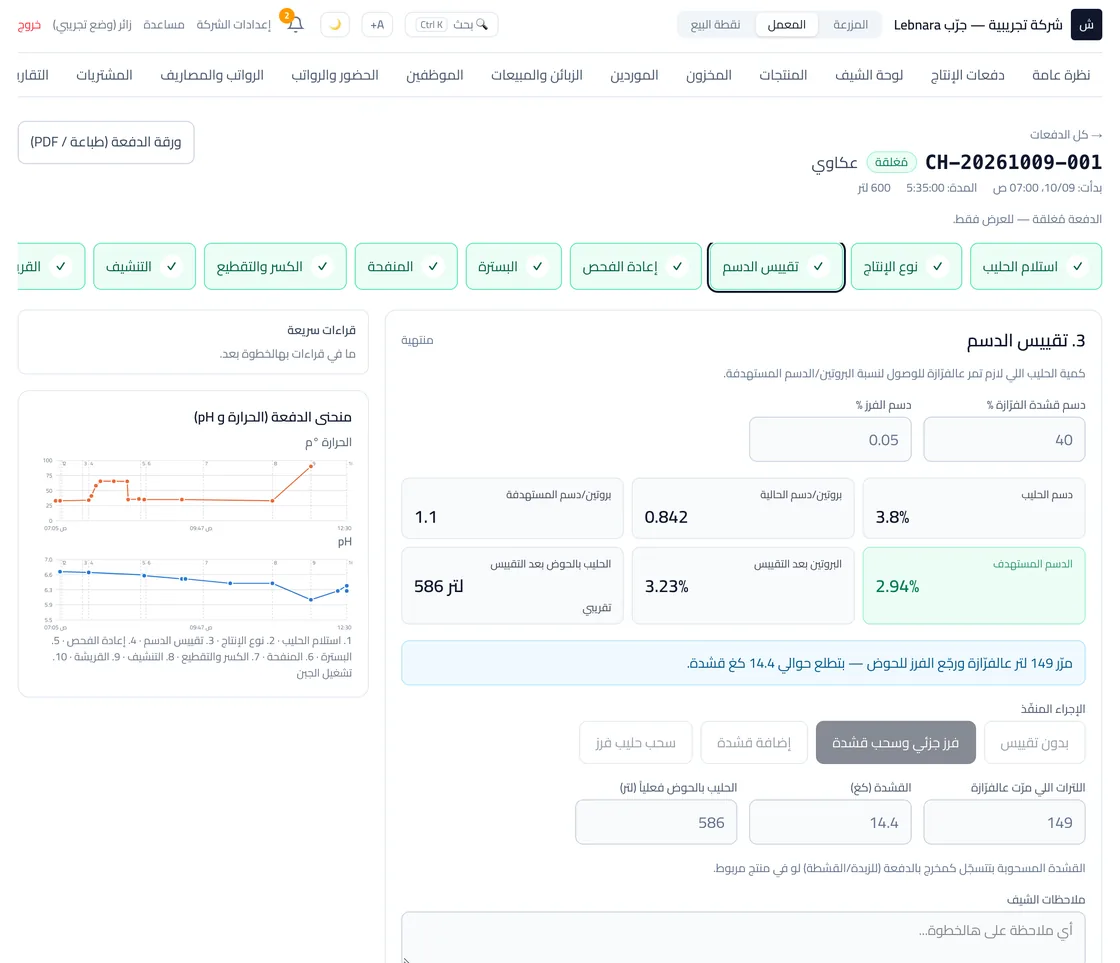
A screen dedicated to the factory chef that walks with him through every batch from milk receipt to finished cheese: fat standardisation by protein-to-fat ratio, rennet dose and cutting time, pH and temperature readings against target, actual yield, and a print-ready HACCP record. When the batch is closed it is posted to production batches automatically.
Designed inside a real factory
Lebnara was built from running a cheese factory and a dairy farm at the same time, so it handles details general accounting software does not know: yields, waste, spreading fixed costs over production, and several products from a single batch of milk.
Frequently asked questions
- How much does the factory module cost?
- The cheese factory module is $20 per month, or $30 per month with the POS.
- Is it suitable for small factories?
- Yes. It was designed mainly for small and medium factories, and you can enable only the modules you need.
- How does it calculate fixed costs?
- It divides monthly costs by 26 working days, then spreads each day's share over the kilograms actually produced that day.
- Does it support van sales for sales reps?
- Yes. Each distribution van has its own stock: the rep loads it from the cold store, sells and collects from customers on the round, and at the end of the day returns what is left and sees the cash to hand in.
- How does it calculate gas and electricity cost per kilo?
- Choose from the energy cost page: a monthly rate you set, a learning mode that learns from last month's expenses, or a calculator that asks about gas, diesel, electricity and weekly output and estimates the cost per kilo.
- How do I know how much salt to add to a brine tank?
- Record the salinity reading (percentage or Baumé) and the tank volume, and the software calculates the kilos of salt to raise salinity to target, or the water to lower it.
Try Lebnara now, no sign-up
A full demo company with every module, opens instantly.